About CeresAgents
Why CeresAgents?
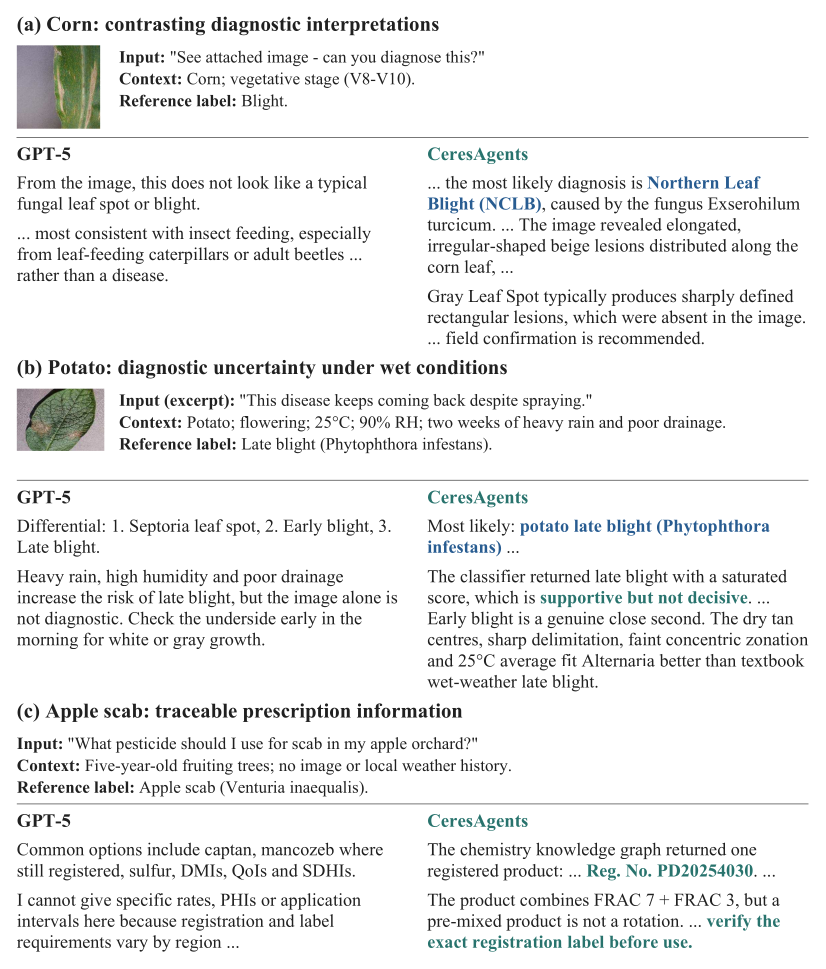
Effective crop-health consultation requires more than a disease label. Pathological interpretation, environmental context, and chemical-management constraints are interdependent: contextual findings may change a diagnosis, and management advice must reflect the available diagnostic and regulatory evidence.
CeresAgents organizes these decisions through task-dependent specialist activation, a shared blackboard, and a structured challenge–rebuttal process when pathological and physiological evidence conflict. Chemical recommendations are checked against crop–disease registration and label-use information, and are withheld when verification is insufficient.
Results and Practical Value
CeresAgents reached 94.89% diagnostic accuracy, a diagnostic score of 91.67, a safety score of 85.13, and an end-to-end quality score of 84.60 on the 267-case CeresBench benchmark. Against the strongest zero-shot baseline for each endpoint, the largest absolute improvement occurred in safety: 30.45 points.
The blinded survey involved 83 participants from 9 countries, 15 universities, and 5 institutes, producing 516 evaluation records. Overall, 74% of preferences favored CeresAgents. These results measure advisory quality and preference; they do not independently establish field-level management outcomes.
Limitations and Future Work
The evaluation uses a manually curated benchmark rather than prospective field deployment. External validation should include unfamiliar diseases, mixed infections, abiotic stress, variable image quality, missing context, and conflicting evidence. Future studies should report tool-call counts, latency, and token costs, and should evaluate localized, regularly updated pesticide-registration evidence.
CeresAgents is intended to assist, rather than replace, local agronomic judgment. Unresolved or high-risk decisions require appropriate local expertise.
Research Team
Authors: Lufu Qin, Jiaying Wang, Xiaodan Wang, Wei Guo, Yuan Li, Zaiwen Feng, Meili Wang, Juntao Xiong, Xiaohong Pan, Yong Wang, Feng Zhou, Warren Jin, Congcong Sun, Ji Zhou, and Qi Wang.
The collaboration spans Guizhou University, HKUST (Guangzhou), China Agricultural University, The University of Tokyo, Chinese Academy of Agricultural Sciences, Huazhong Agricultural University, Northwest A&F University, South China Agricultural University, Fujian Agriculture and Forestry University, Henan Institute of Science and Technology, CSIRO, Wageningen University, and NIAB.
Correspondence: congcong.sun@wur.nl (C.S.) · JZhou@cemps.ac.cn (J.Z.) · qiwang@gzu.edu.cn (Q.W.)