CeresAgents (A multi-agent diagnosis-to-prescription framework for safety-aware crop disease management)
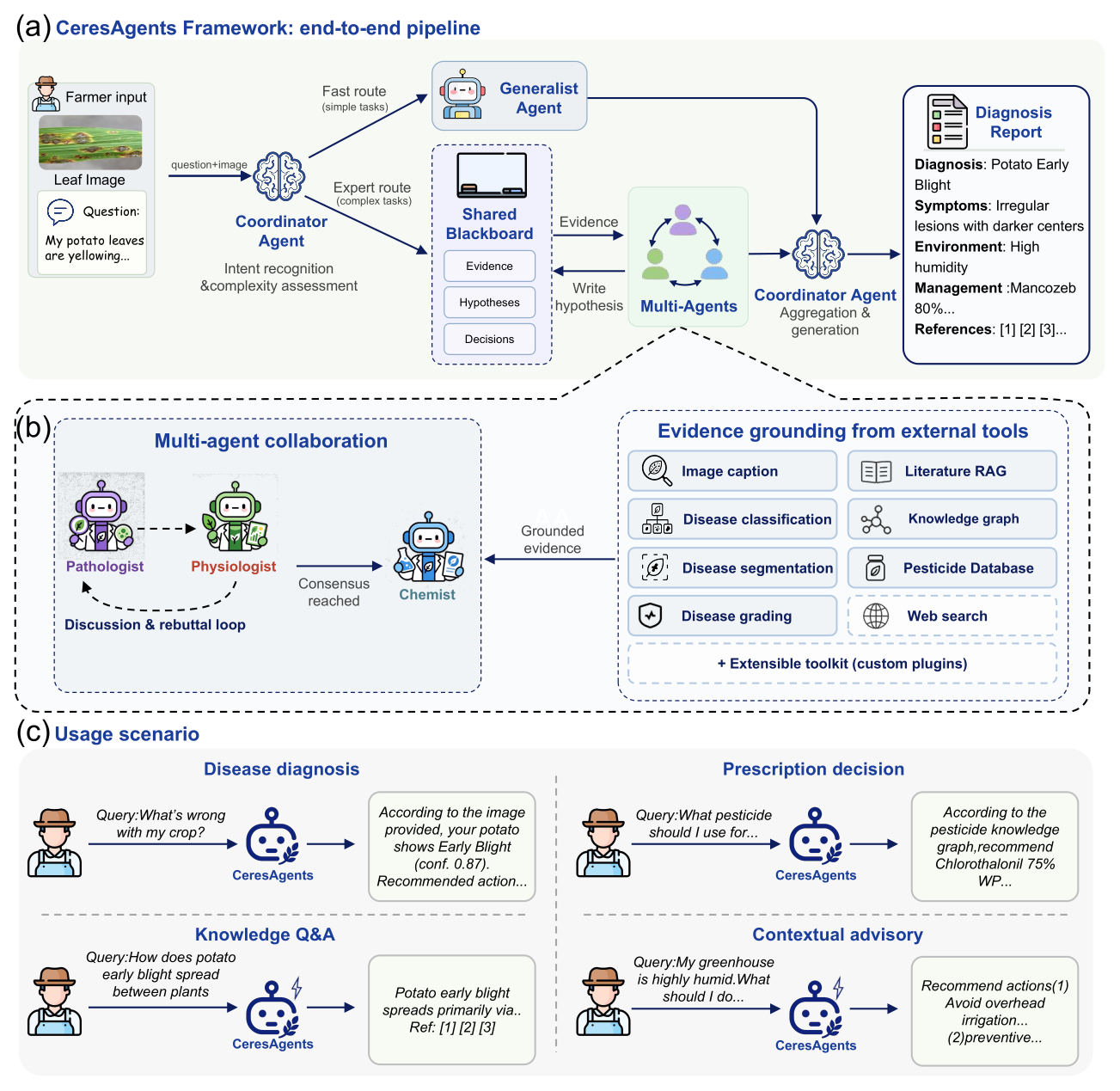
Crop disease management requires more than symptom recognition: diagnoses must account for field context, and chemical recommendations must satisfy registration and label-use constraints. Although vision models and large language models support parts of this process, coordinating diagnostic evidence and treatment decisions remains challenging. We present CeresAgents, a task-adaptive multi-agent framework for evidence-grounded and safety-aware crop disease management.
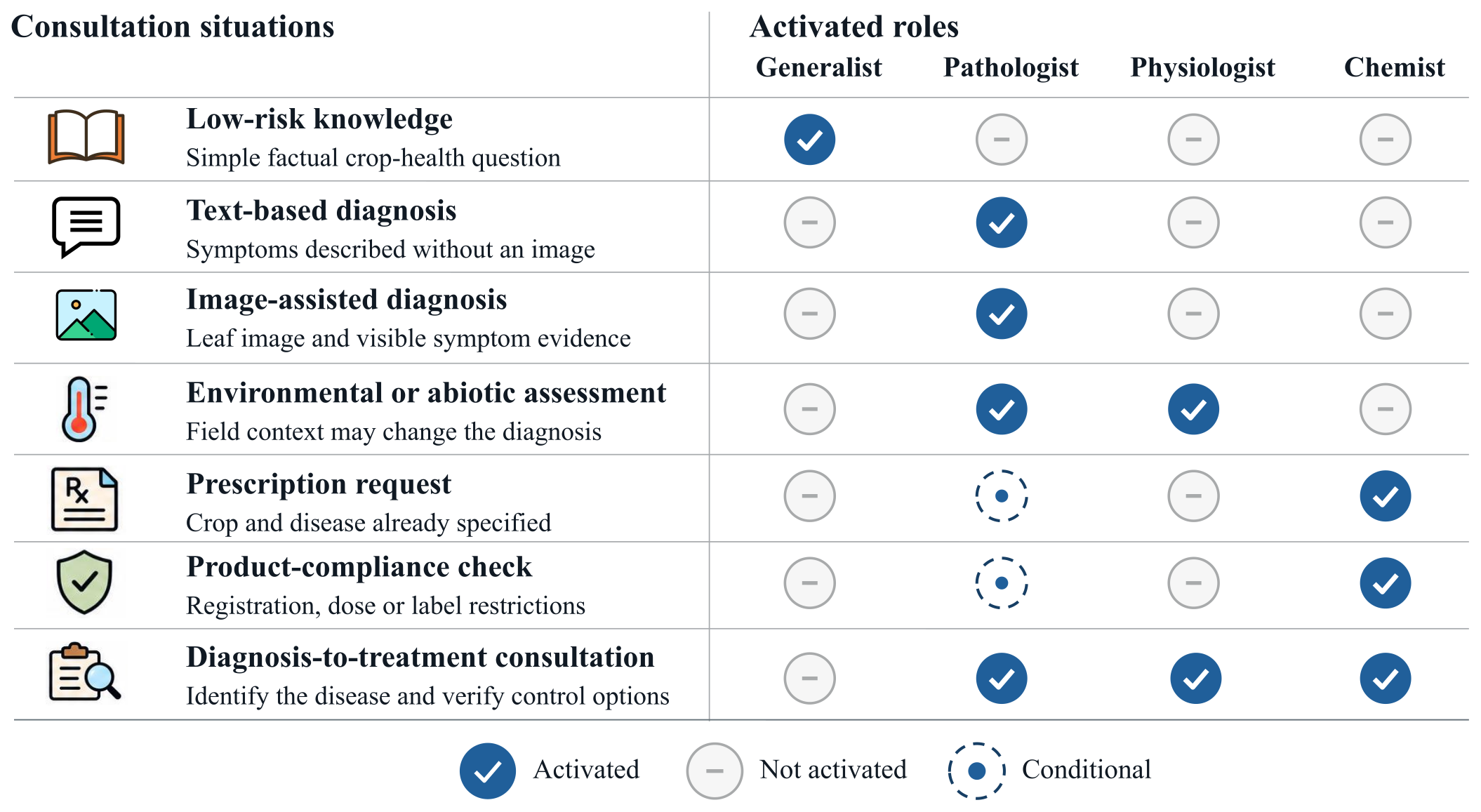
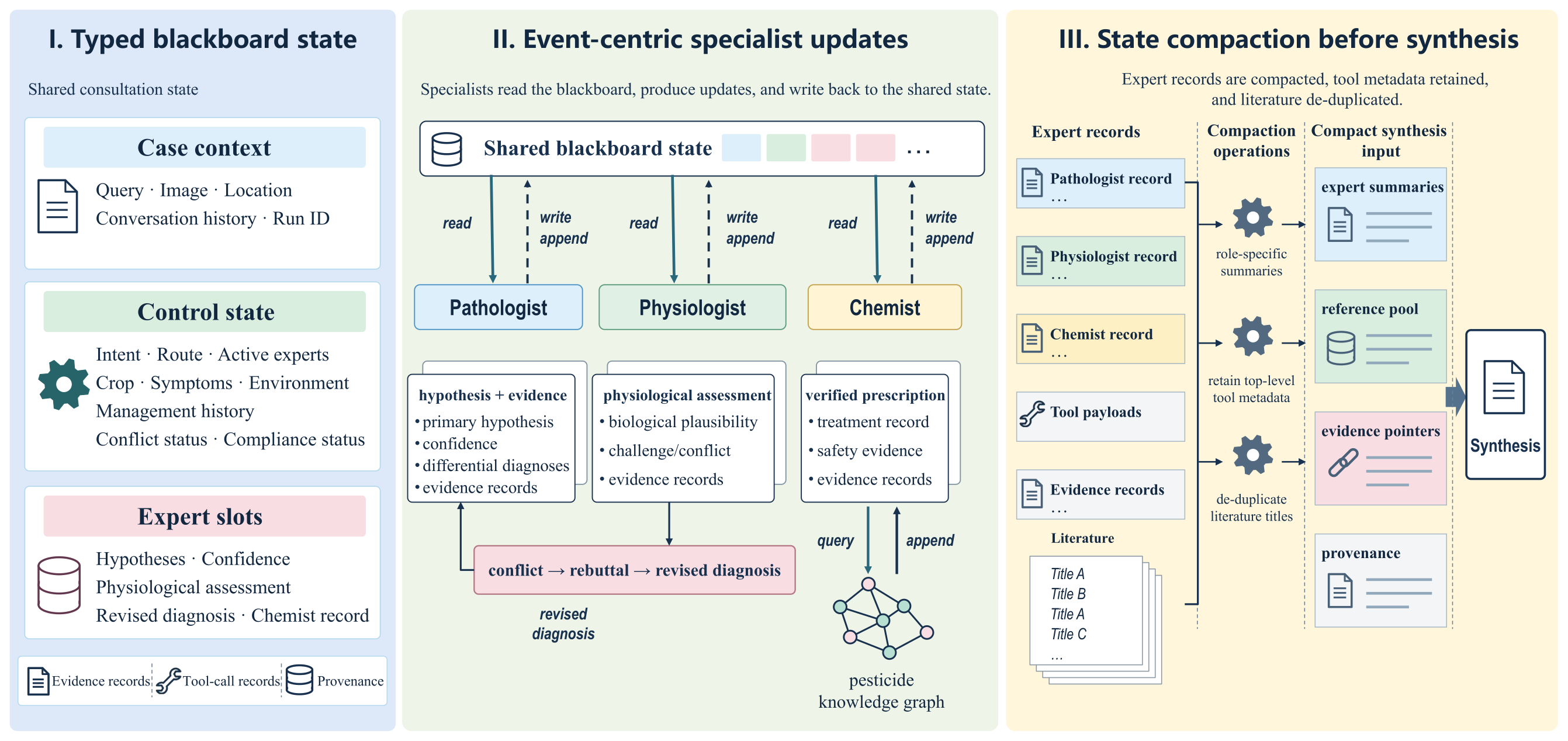
An intent-based coordinator selectively activates pathology, physiology, and chemistry specialists according to consultation requirements. Through a shared blackboard, specialists exchange diagnostic findings and contextual evidence, enabling structured reassessment when pathological and physiological interpretations conflict. Visual disease models and hybrid-contextual literature retrieval support disease identification and differential reasoning, while a chemistry specialist uses a pesticide knowledge graph to verify candidate recommendations against available crop–disease registration and label-use information.
We evaluate CeresAgents on CeresBench, a manually curated benchmark of 267 cases spanning seven task tracks. CeresAgents achieved 94.89% diagnostic accuracy and an 84.60 end-to-end quality score, outperforming four direct foundation-model baselines. Compared with a single agent using the same backbone and evidence tools, CeresAgents improved safety by 16.69 points.
Contributions.
- We develop a task-adaptive multi-agent architecture that coordinates pathology, physiology, and chemistry specialists through a shared blackboard.
- We integrate visual analysis, hybrid-contextual literature retrieval, and pesticide-registration knowledge to support evidence-grounded recommendations and withhold chemical prescriptions when evidence is insufficient.
- We introduce CeresBench to evaluate routing, tool selection, diagnosis, prescription, safety, conflict handling, and end-to-end advisory quality.
| October 20, 2026. CeresAgents project page update. |